
Design, Materials, Craft: The Three Things That Make a Home Last
Why longevity in a build isn't accidental, and what it takes to achieve it.

There's a version of building where design, materials and craftsmanship are treated as separate concerns. The designer finishes their drawings, hands them to the builder, and the builder goes to work. Materials are chosen from a schedule. Trades come in and do their part. The result is a home that may look the part at handover but starts showing its age, and its compromises, sooner than anyone expected.
A home that genuinely lasts is something different. It's the result of design, materials and craft working together from the beginning, each one informing the others, each one held to a standard the finished building can carry for decades.
Design: how people live, not just how it looks

Good design is often talked about in terms of aesthetics. But aesthetics are the surface of it. What design actually determines is how a home functions for the people inside it.
A home with poor flow, inadequate storage, badly proportioned rooms or misaligned orientation to the sun is a home that its occupants will work around for as long as they live there. Those compromises accumulate. Rooms get repurposed. Extensions get added. Things get fixed that should never have been a problem.
Good design considers orientation, how a home sits on its site relative to sun, prevailing wind and views. It considers the relationship between spaces: how the kitchen connects to the outdoor area, how natural light reaches the rooms where people spend the most time, how a family moves through the house across the course of a day. It considers what happens to the home as the people in it change, children growing up, older relatives staying, working from home.
In the Macedon Ranges, good design also means responding to climate. A home that doesn't account for cold winters, summer heat and sun orientation is a home that will be expensive to live in and uncomfortable at the extremes of the year. Passive solar principles, correct orientation, appropriate eaves depth, thermal mass in the right places, are design decisions that pay dividends for the entire life of the building. They cost nothing to implement at design stage and cannot be retrofitted cheaply once the home is built.
The result of good design isn't that the home looks impressive in photographs. It's that the people living in it never feel like they're working against it.
Materials: physical resilience over time
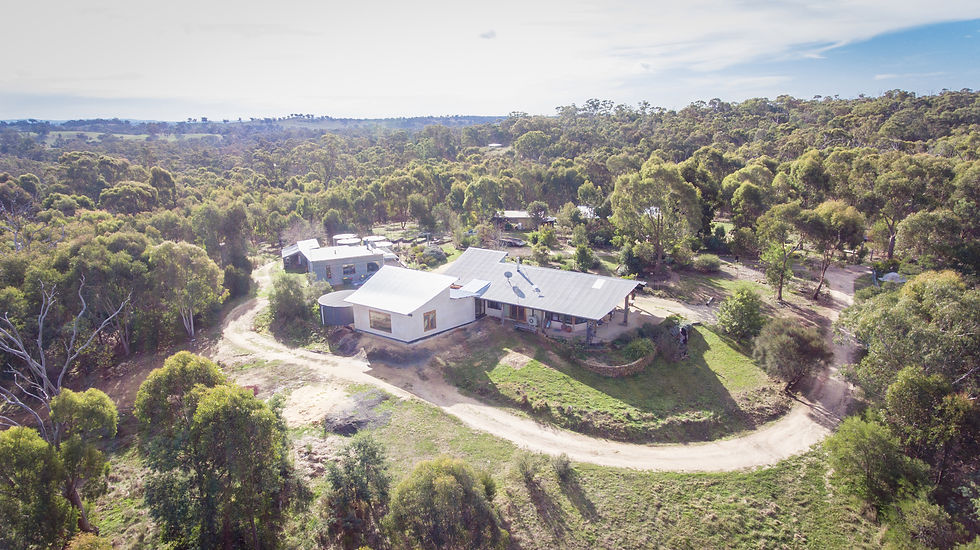
Material selection determines how a building performs over decades, not just in the first year after handover. The cheapest material is rarely the most economical over time. What it saves at the point of purchase it often costs back in maintenance, early replacement or performance failure.
Materials need to be right for the climate and the context. In central Victoria, that means exposure to genuine cold, significant UV, seasonal moisture and in many areas bushfire risk. A material that performs well in a coastal or urban environment may deteriorate quickly on a rural Macedon Ranges property. Getting this right requires understanding not just what materials cost but how they age.
Material compatibility also matters more than most people realise. Different materials expand and contract at different rates with temperature change. Where incompatible materials meet, at junctions, flashings, penetrations, problems develop over time. Correct detailing at these points is one of the things that separates a build that stays watertight for thirty years from one that develops problems in five.
Thermal performance is embedded in material choice in ways that aren't always visible. The insulation in the walls, the thermal mass in the floor, the glazing specification, these determine how much energy the home needs to stay comfortable for the rest of its life. Getting them right costs no more than getting them wrong, but requires the knowledge to make the right decisions at the right time.
Craft: the execution that brings it together

Good design and quality materials are only as good as the craftsmanship that executes them. The same plans and the same specification in different hands produces different results, sometimes visibly, often not until problems emerge years later.
Craftsmanship shows in the things you don't see. Correct waterproofing at wet areas. Accurately cut and fitted framing that stays square and plumb. Flashings installed with the detail they need to remain effective. Insulation installed without gaps or compression. These are the things that don't appear in a finished photograph but determine whether the building performs as designed over its lifetime.
It also shows in what you do see. Joinery that fits cleanly, render that holds its finish, tiling that aligns and doesn't hollow. These aren't cosmetic details, they reflect the care and knowledge behind the work, and they distinguish a finished home from one that just looks finished.
Craftsmanship is also about understanding why, not just how. A tradesperson who knows why a detail is done a certain way will find the right solution when site conditions mean the textbook approach isn't possible. One who only knows the sequence will either do it wrong or treat every variation as a problem. On a bespoke architectural build, the gap between these two approaches shows.
Longevity: what happens when all three work together

A home built from quality materials with skilled craftsmanship but poor design will frustrate the people living in it. A well-designed home built with craft but the wrong materials will deteriorate before its time. A home with good design and good materials but poor execution will develop problems at every junction and penetration.
Longevity is what happens when none of these things is the weak link. Functional longevity, the home keeps working for the people in it as their lives change. Material longevity, the building holds its performance and its appearance without constant maintenance. Structural longevity, the home remains sound for generations.
This doesn't happen by accident, and it doesn't happen because a builder simply tries hard. It happens because good decisions are made early, at design stage, at material selection, at the start of every trade package, and because those decisions are executed with the knowledge and care they require.
From the first sketch to the final nail, every decision either adds to or subtracts from the longevity of the finished building. The role of a builder who takes that seriously is to make sure the ledger is always running in the right direction.


Comments